General information about emails and email delivery, including that related to emails being used for group discussion and email lists.

If you manage an email list for an association, nonprofit, or institution, your open rate is probably the first number you check after a send. It is also the number most likely to mislead you. Almost every guide to open rate is written for campaign marketers using Mailchimp or similar tools.

If managing your organization’s email list has started to feel like a second job, you are probably running it without a system. The good news is that the fix is not complicated. The email management strategies that work for group lists are different from the inbox habits that personal productivity guides recommend.

Most advice about email in business communication assumes you are one person writing to one other person. If you run a mailing list for your organization, that assumption breaks. Every message you send lands in dozens or thousands of inboxes at once, so the familiar etiquette rules need rewriting for the group. This guide covers the rules, the tone, reply-all, and the policy that keep a business email list useful instead of noisy.

If you run a mailing list for an association, a nonprofit, an alumni office, or a school, most advice on how to improve email engagement was written for marketers, and it does not quite fit what you are trying to do. You are not running a campaign to drive sales. You are keeping a group of members informed, or hosting a discussion they take part in. Engagement, for you, means members read what you send, reply when it matters, and stay on the list.

Email marketing remains remarkably effective, despite predictions of its demise. The numbers speak for themselves: there are now 4.73 billion email users worldwide, and this figure continues to grow. In the UK specifically, email delivery rates reached 98% in 2024, whilst open rates climbed to 35.9% – the highest in years.

CRO stands for conversion rate optimization. In a group email or mailing list context, CRO means improving the percentage of people who complete a desired action: signing up for the list, confirming their subscription, completing a free trial, or staying active as members.

The rules for email subject lines have fundamentally shifted since 2021. Apple Mail Privacy Protection now inflates open rates for roughly half of all email recipients, Gmail’s 2025 Promotions tab redesign ranks emails by relevance rather than recency, and over 60% of emails are now opened on mobile devices with limited character display.

Email segmentation is the practice of dividing an email list into smaller groups based on shared characteristics, so each group receives messages relevant to its members.

Email analytics for group email lists focuses on delivery infrastructure signals, not behavioral engagement signals. The metrics that matter are delivery rate (the percentage of messages that reached member mail servers), bounce rate (the percentage that failed permanently or temporarily), complaint rate (the percentage of recipients who marked messages as spam), and unsubscribe rate (the percentage who opted out).

Communication for universities operates across three distinct audiences: current students, faculty and staff, and alumni. Each audience has different information needs, different communication expectations, and different relationships with the institution.
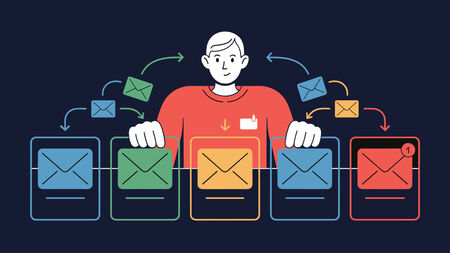
Email segmentation is the practice of dividing an email list into smaller groups and sending each group a message tailored to their needs.

The email customer journey is a well-established idea in digital marketing. Most definitions describe a funnel: prospect receives a promotional email, clicks a link, buys something, and either becomes a loyal customer or churns. That model works for ecommerce and SaaS. It does not describe what happens on a group email list.